
About the artwork
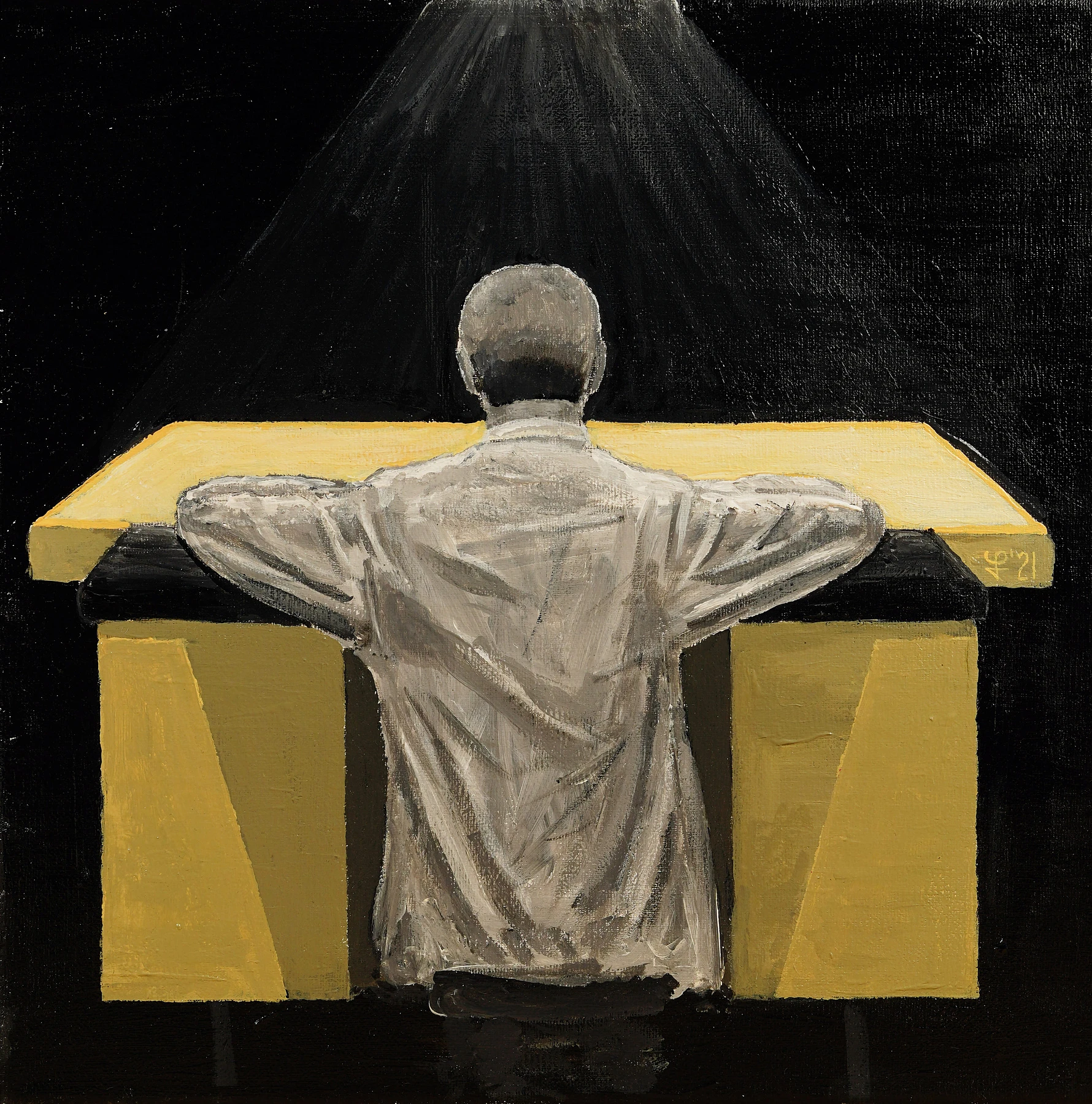
In ‘Self-Portrait’, Konstantin Chaykin depicts himself with his back to the viewer at a workbench, facing a surface still empty of tools and details. This is already the artist's third authorial return to his own image, following the unique 2019 ‘Joker Selfie’ watch, and this time the idea is realized not in metal but in artwork. This emptiness reads not as absence but as promise: the watchmaker and inventor is contemplating ideas yet to come, and the Workbench as a Model of the Universe once again awaits its first day of creation.
The compositional solution deliberately references Caspar David Friedrich's artwork ‘Wanderer above the Sea of Fog’ (1818), one of the most recognizable images of German Romanticism, in which a figure atop a cliff likewise stands with its back to the viewer, facing not us but an unbounded, misty expanse ahead. This device, a figure turned away, denies the viewer any reading of the hero's expression and thus compels them to project onto him their own thoughts about the future and the border of the known. Like Friedrich's wanderer, Chaykin's figure gazes not into fog but into the as yet unfilled space of the workshop, and this shift, from a natural landscape to an engineering workbench, constitutes the principal distinction of the artist's reading of the Romantic motif.
Universum "The Figure of the Author"
The compositional solution deliberately references Caspar David Friedrich's artwork ‘Wanderer above the Sea of Fog’ (1818), one of the most recognizable images of German Romanticism, in which a figure atop a cliff likewise stands with its back to the viewer, facing not us but an unbounded, misty expanse ahead. This device, a figure turned away, denies the viewer any reading of the hero's expression and thus compels them to project onto him their own thoughts about the future and the border of the known. Like Friedrich's wanderer, Chaykin's figure gazes not into fog but into the as yet unfilled space of the workshop, and this shift, from a natural landscape to an engineering workbench, constitutes the principal distinction of the artist's reading of the Romantic motif.
The depiction of Time, in the many forms it takes, is what defines my own artistic language — Horological Art.