
About the artwork
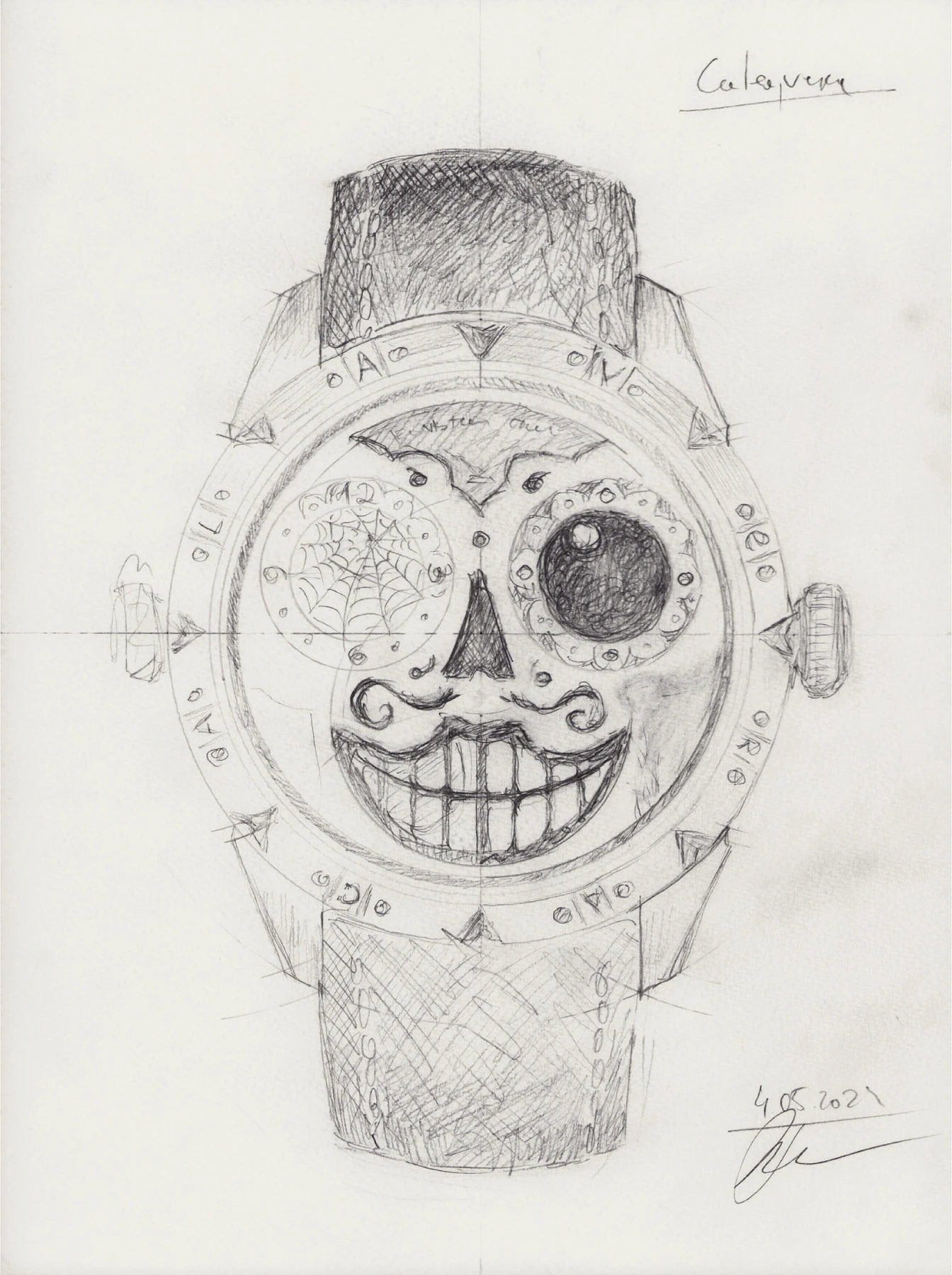
‘Calavera’ is Konstantin Chaykin's first watch dedicated to Mexico and its cultural heritage. The idea of creating such a Wristmon was inspired by the tradition of sugar skulls, decorative skulls crafted by Mexican artisans for the Day of the Dead (El Día de Muertos), made from sugar and painted by hand. This tradition represents an important part of the country's cultural code, a collection of remarkably expressive and striking artistic images backed by a long-standing tradition, one reaching back to pre-Hispanic conceptions of death not as an end but as a continuation of the Universum, akin in this sense to that idea of time as a cultural category which Chaykin develops elsewhere in his work.
As a rule, Konstantin Chaykin tries to keep decorative elements in his executions to a minimum. Original sugar skulls, however, abound in multicoloured ornamental details. Nevertheless, when creating his own interpretation of this decoration, and, in a sense, a distilled essence of the El Día de Muertos style, the master chose to work with the barest means: the ornaments are suggested only by subtle hints, and the palette is limited to four main colours, red, light blue, dark blue, and black, together with the essential silvery-white "sugar" background. Here arises a paradox characteristic of the Chaykin Method: the richer and more ornate the source, the stricter the drafting structure of its artistic translation. The abyss-black rotating eyes serve as the time indicators, while the signature Wristmon lunar smile shows the current moon phase through a black grid traditionally representing the toothy grin of a sugar skull, thereby transforming a funerary symbol into a Horological Archetype through the principle of anthropomorphism.
Universum ‘Horological Graphic Art’
As a rule, Konstantin Chaykin tries to keep decorative elements in his executions to a minimum. Original sugar skulls, however, abound in multicoloured ornamental details. Nevertheless, when creating his own interpretation of this decoration, and, in a sense, a distilled essence of the El Día de Muertos style, the master chose to work with the barest means: the ornaments are suggested only by subtle hints, and the palette is limited to four main colours, red, light blue, dark blue, and black, together with the essential silvery-white "sugar" background. Here arises a paradox characteristic of the Chaykin Method: the richer and more ornate the source, the stricter the drafting structure of its artistic translation. The abyss-black rotating eyes serve as the time indicators, while the signature Wristmon lunar smile shows the current moon phase through a black grid traditionally representing the toothy grin of a sugar skull, thereby transforming a funerary symbol into a Horological Archetype through the principle of anthropomorphism.
Time is not merely a measure. It is a philosophical dimension, an inexhaustible source of inspiration, and the central subject of my art universe.