
About the artwork
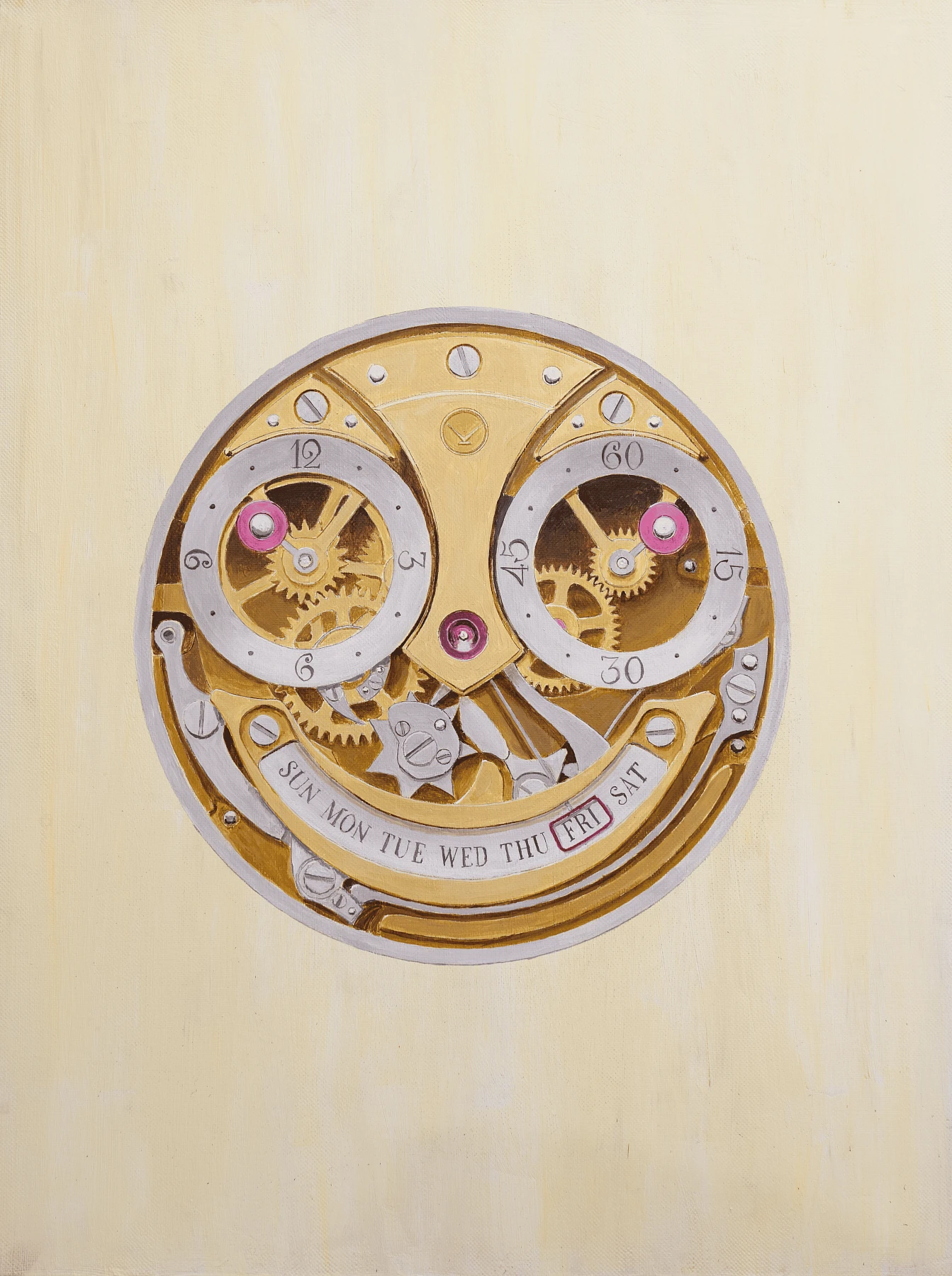
The artwork 'Sandmann' is built at the interUniversum of two cultural layers, united by a single mechanical metaphor. The first source of inspiration, Hoffmann's short story 'The Sandman,' drew the master through its image of the automaton, an artificial being resembling at once a human and a movement. The figure proved close to Chaykin's own practice, which builds painted characters from the components of a watch movement. Hoffmann's tale unfolds on the border between clarity and confusion of mind: the student Nathanael falls in love with Olympia, a beautiful doll he mistakes for a living girl. This confusion defines the tale's mood, anxious, unstable, charged with the presentiment of deception. In Chaykin's artwork, a faint haze marks the boundary between reality and imagination. Time appears there as a living, enigmatic, and slightly unsettling creature. It resembles Hoffmann's automatons, whose mechanical nature reveals itself only gradually.
The second layer draws on the Russian expression the sands of time, which connects the inexorability of the moment to the flow of sand through an hourglass. The gilded details of the Horological Archetype appear dusted with golden sand, as though the very surface of the canvas were governed by that same deceptive, unstable light that once captivated Hoffmann's hero. For the palette, Konstantin Chaykin chooses ochre because, beyond conveying the properties of sand, this tone also echoes the effect of sandblasted metal. The artwork becomes an allegory of a high order, where the fairy-tale automaton and the real watch movement prove to be two facets of the same mystery of time.
Universum "Horological Archetypes"
The second layer draws on the Russian expression the sands of time, which connects the inexorability of the moment to the flow of sand through an hourglass. The gilded details of the Horological Archetype appear dusted with golden sand, as though the very surface of the canvas were governed by that same deceptive, unstable light that once captivated Hoffmann's hero. For the palette, Konstantin Chaykin chooses ochre because, beyond conveying the properties of sand, this tone also echoes the effect of sandblasted metal. The artwork becomes an allegory of a high order, where the fairy-tale automaton and the real watch movement prove to be two facets of the same mystery of time.
In Haute Horology, an idea is resolved into engineering. In artwork, it remains a living thought, captured in the moment.