
About the artwork
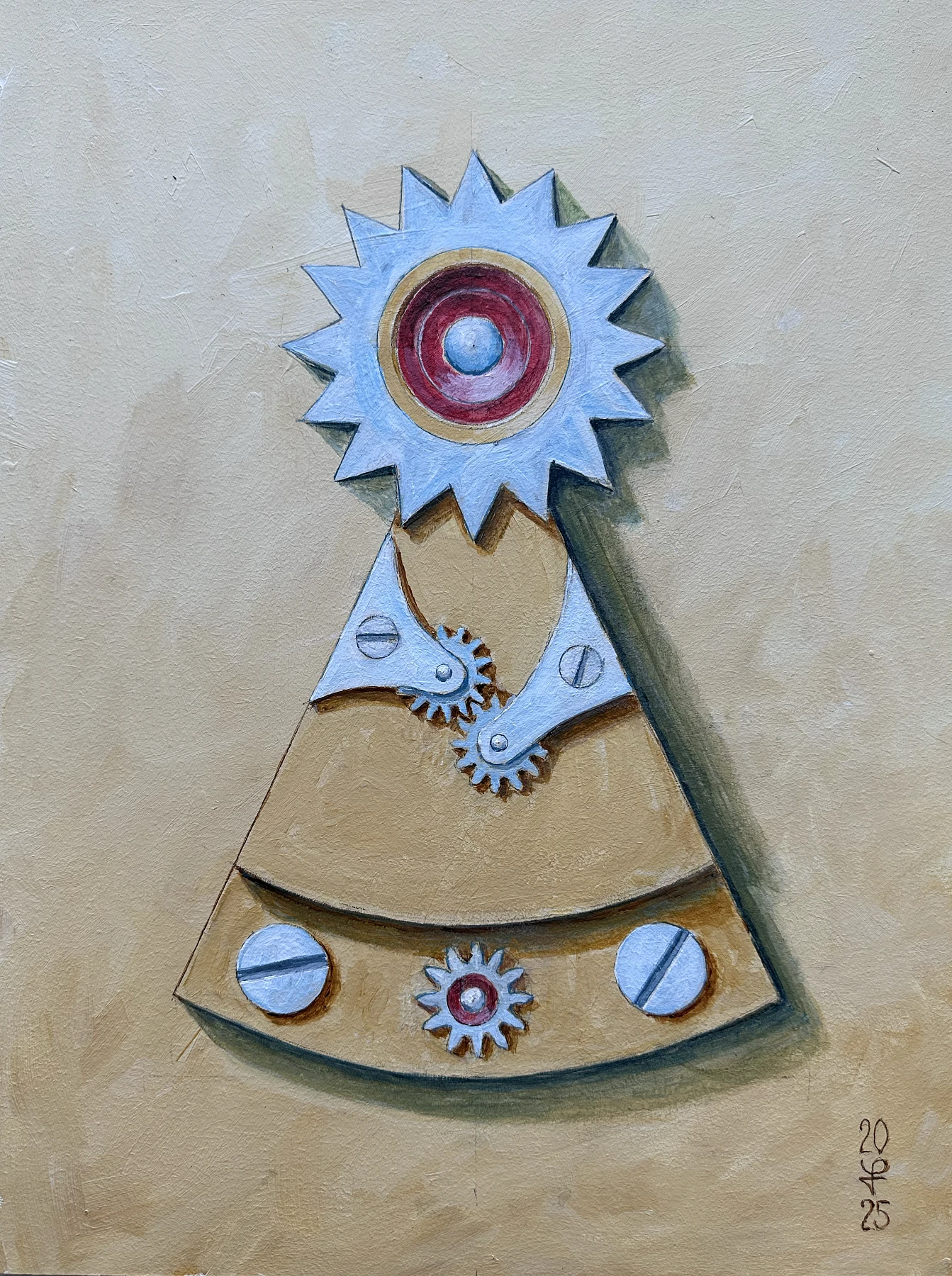
The concept underlying the artwork is bound up with the number twelve, which orders nature, calculation, and thought all at once. Twelve hours of day and night, twelve months of the year, twelve signs of the zodiac: in every one of these systems, the number twelve functions as a mathematical necessity, since it divides evenly by two, three, four, and six, and is therefore ideally suited to dividing a circle, whatever that circle may be, a dial or the vault of heaven. Pythagoras saw in this divisibility a sign of special harmony, and Plato, in the 'Timaeus', associated the dodecahedron, the fifth of the regular solids, precisely with the shape of the Universe as a whole, distinguishing it in this way from the four solids corresponding to the earthly elements. In 'Dodeca,' Konstantin Chaykin sought to hold both meanings of the number twelve, the numerical and the cosmological, within a single image.
The artwork gives rise to a Horological Archetype where mechanical form is joined to the sacred symbolism of number. The artwork's central object, a twelve-toothed star, is deliberately ambiguous: it reads at once as the wheel of a watch movement and as a cosmic sign of the twelve hours, months, and constellations, and neither reading takes precedence over the other. Like 'Sedmitsa' or 'Goddess of Tempo,' 'Dodeca' extends Chaykin's gallery of Horological Archetypes, where a technical detail is granted the right to philosophical meaning. The twelve radiating teeth trace back to ancient conceptions of numerical harmony, from the Pythagoreans' dodecahedron to Plato's idea of a perfect form reflecting the hidden symmetry of the cosmos and of the wheel of human fate, and in this way a single component of a watch movement rises to the level of an allegory of a high order, joining a visual philosophy of time to the legacy of ancient thought.
Universum "Horological Archetypes"
The artwork gives rise to a Horological Archetype where mechanical form is joined to the sacred symbolism of number. The artwork's central object, a twelve-toothed star, is deliberately ambiguous: it reads at once as the wheel of a watch movement and as a cosmic sign of the twelve hours, months, and constellations, and neither reading takes precedence over the other. Like 'Sedmitsa' or 'Goddess of Tempo,' 'Dodeca' extends Chaykin's gallery of Horological Archetypes, where a technical detail is granted the right to philosophical meaning. The twelve radiating teeth trace back to ancient conceptions of numerical harmony, from the Pythagoreans' dodecahedron to Plato's idea of a perfect form reflecting the hidden symmetry of the cosmos and of the wheel of human fate, and in this way a single component of a watch movement rises to the level of an allegory of a high order, joining a visual philosophy of time to the legacy of ancient thought.
In Haute Horology, an idea is resolved into engineering. In artwork, it remains a living thought, captured in the moment.