
About the artwork
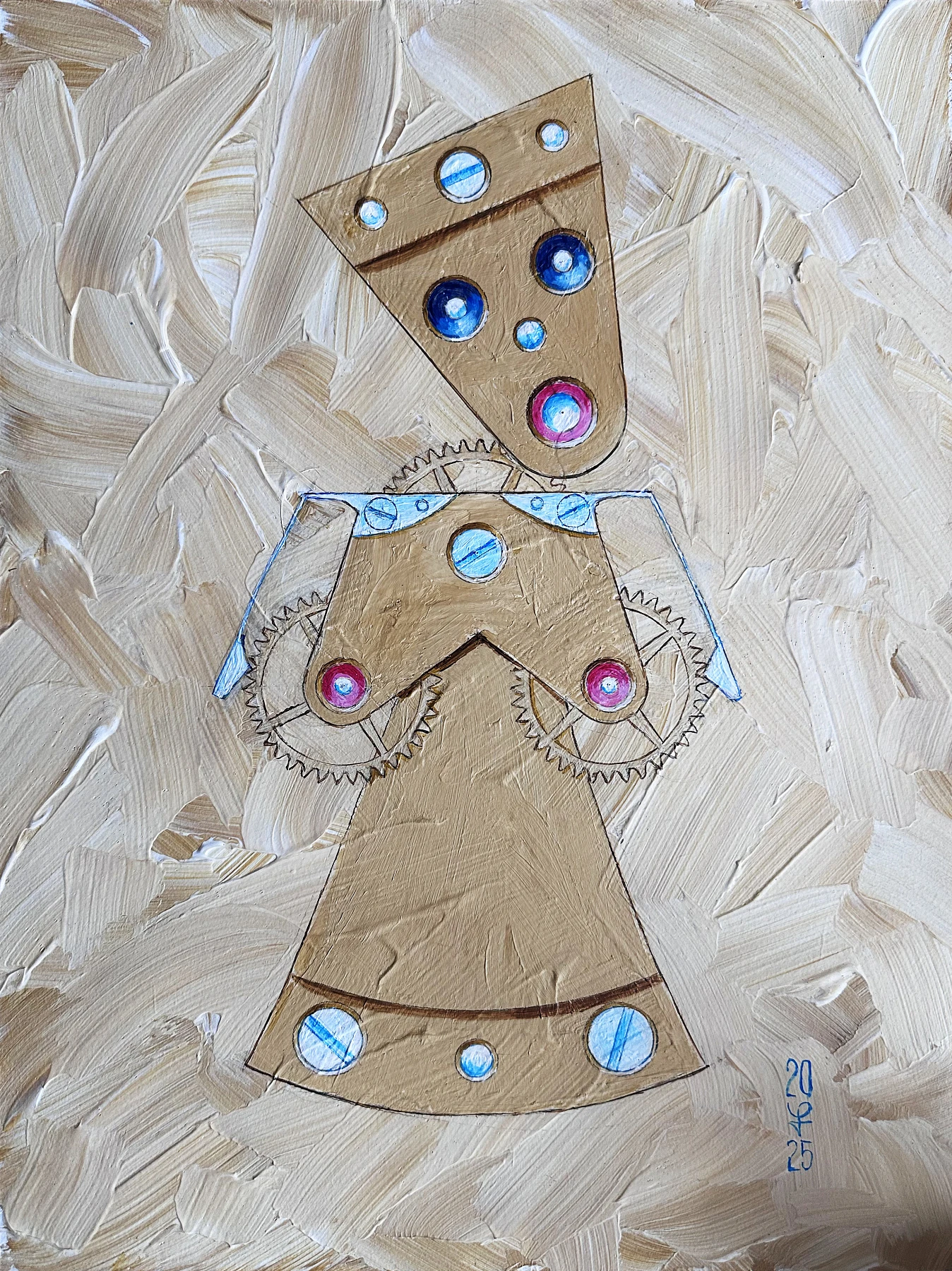
At the core of the painting ‘Chronobust’ lies the principle of merging a female image with the watch movement. The master places at the centre of the composition a bust — a fragment of the body which, by tradition, has often been associated with life force and fertility. In the painting, it becomes an allusion to time itself. The main emphasis is placed on the body of the Horological Archetype, assembled from gears. Chaykin shifts the focus from individual character to a universal principle, according to which time appears not as an abstraction but as something more concrete and tangible. The breast, constructed from gears, becomes an allegory of this process, where every element works toward image.
Chaykin builds the painting as a construction in which body and mechanism are inseparable. In this work, there is no conflict between sensuality and precision — they coexist as two sides of a single whole. Gears become anatomy, and ruby stones unite the human and the engineering in a single point. In this work, Chaykin asserts that time does not exist outside matter, and matter does not exist without time. ‘Chronobust’ becomes the archetype of this unity, where body and movement merge into an image in which time ceases to be a measure and becomes a form of existence.
Universum "Horological Archetypes"
Chaykin builds the painting as a construction in which body and mechanism are inseparable. In this work, there is no conflict between sensuality and precision — they coexist as two sides of a single whole. Gears become anatomy, and ruby stones unite the human and the engineering in a single point. In this work, Chaykin asserts that time does not exist outside matter, and matter does not exist without time. ‘Chronobust’ becomes the archetype of this unity, where body and movement merge into an image in which time ceases to be a measure and becomes a form of existence.
In Haute Horology, an idea is resolved into engineering. In artwork, it remains a living thought, captured in the moment.