
About the artwork
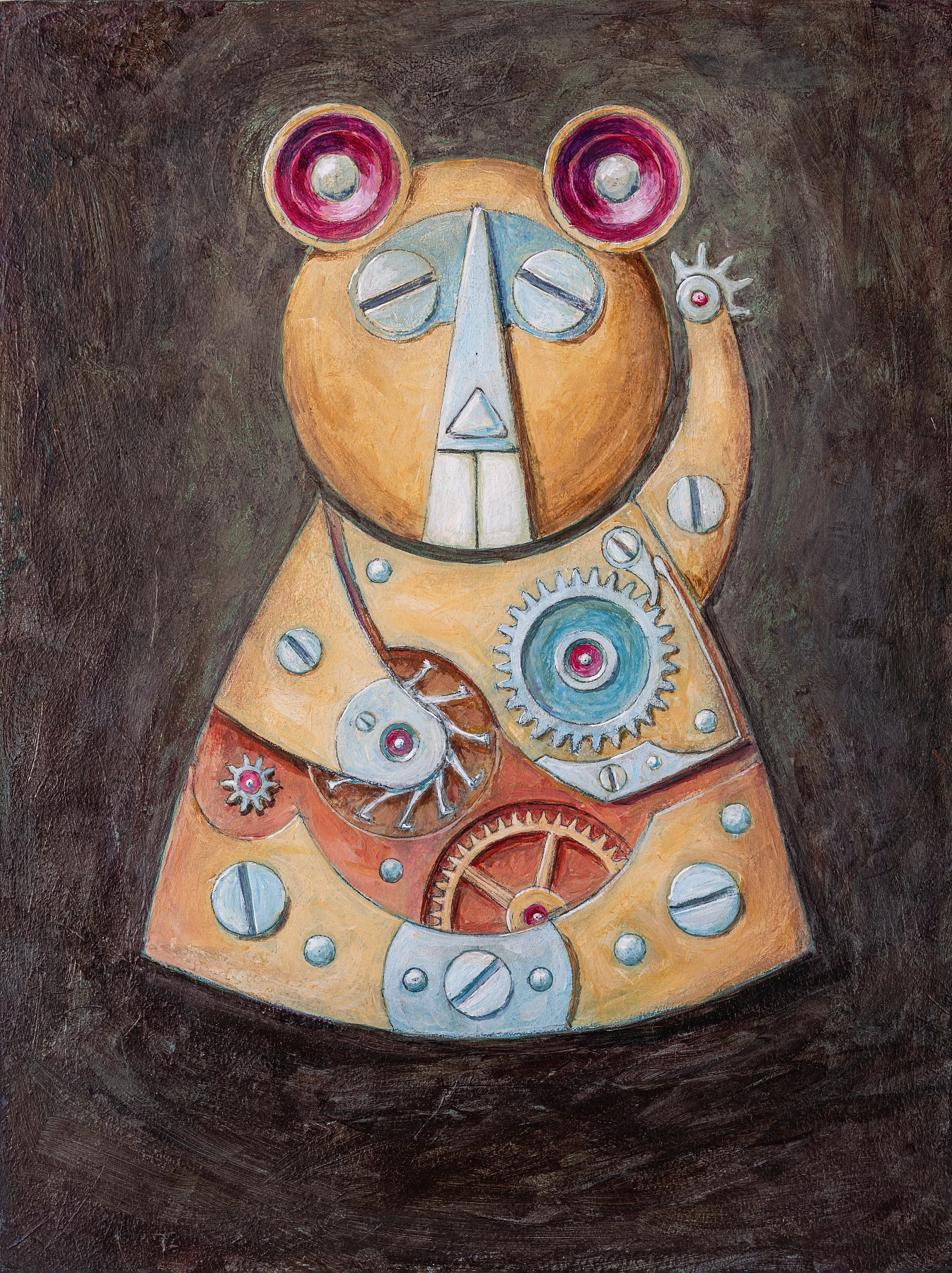
‘Dormouse’ is a study for the ‘Alice in Wonderland’ Universum, where Konstantin Chaykin reinterprets a character from Lewis Carroll's tale through the language of Horological Art. The image is built on a paradox of continuity: the ever-sleeping Dormouse becomes a horological archetype, embodying a watch movement's ability to function regardless of its external state. Her sleep does not stop the device from working. On the contrary, the mechanical metaphor achieves its greatest expressiveness precisely in this state of rest. This paradox is already embedded in the character's name, ‘Dormouse.’ It traces back to the French verb dormir (‘to sleep’) and is built on the contrast between outward passivity and inner activity. The Dormouse dozes in a teapot, yet at the same time tells a story to the other characters at the tea party. Chaykin translates this paradox into the language of Horological Art: the watch components take on the character's personality, and this anthropomorphism turns a mechanical assembly into a living creature.
Chaykin deliberately chooses acrylic and fiberboard for the work's execution. Unlike oil artwork with its soft transitions, this material conveys the sharp lines and density of color that reveal the archetype without distortion, and the fiberboard provides the firmness needed for the paint to lie evenly and hold its shape. This technique brings the classical painted canvas under the logic of a watch movement, which lies at the heart of Horological Art.
Universum ‘Alice in Wonderland’
Chaykin deliberately chooses acrylic and fiberboard for the work's execution. Unlike oil artwork with its soft transitions, this material conveys the sharp lines and density of color that reveal the archetype without distortion, and the fiberboard provides the firmness needed for the paint to lie evenly and hold its shape. This technique brings the classical painted canvas under the logic of a watch movement, which lies at the heart of Horological Art.
I do not paint archetypes. I construct them, as one constructs a watch movement: through structure, mechanics, and the logic of time.