
-
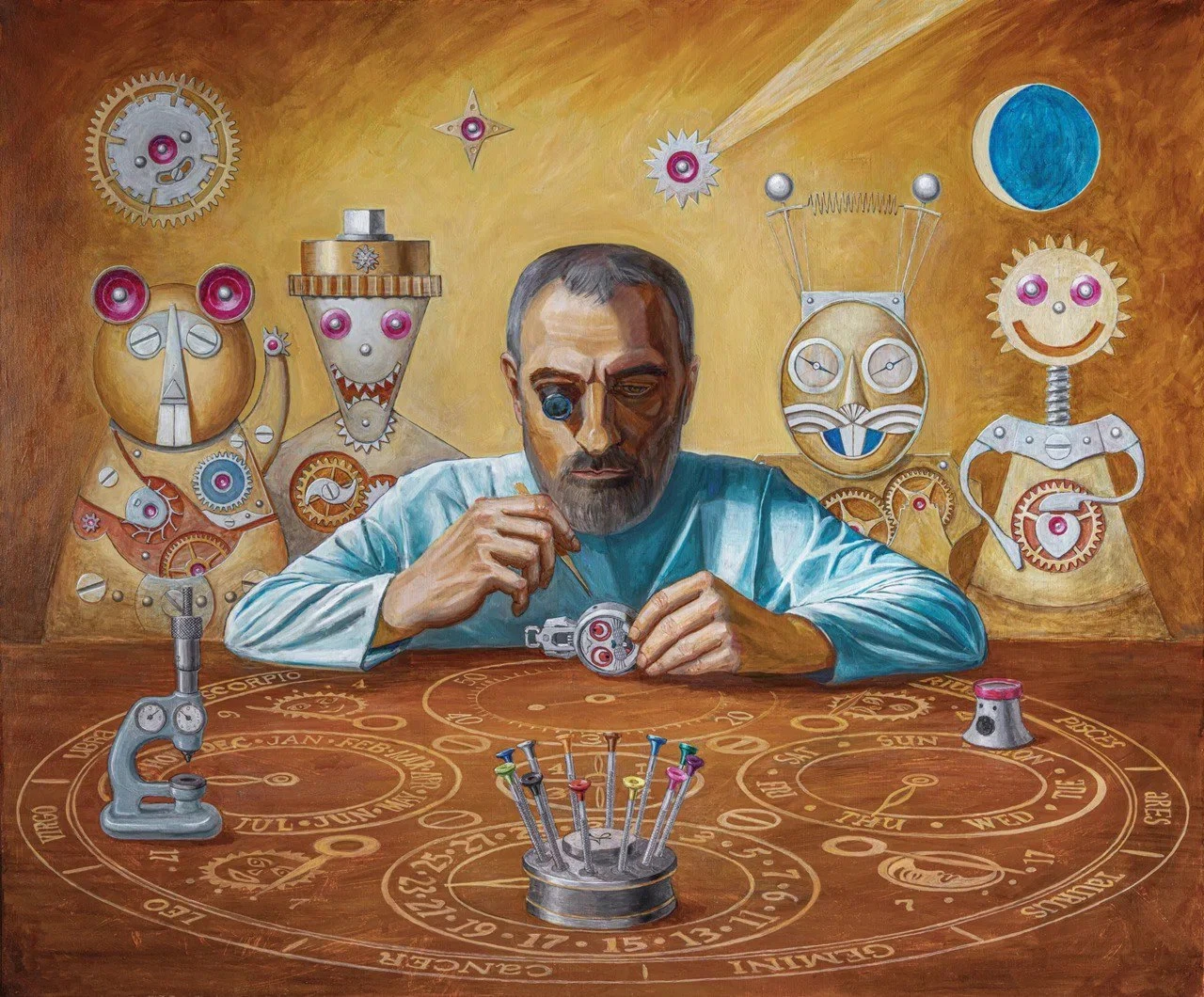
The surreal Sun of the surreal world of Alice in Wonderland, created in Chaykin’s imagination, is shown as the 48-month program cam of the perpetual calendar mechanism of the “White Rabbit” watch. Moreover, this detail resembles the head of the eternal wanderer from Chaykin’s painting Ahasuerus, which was also created based on motifs from the “White Rabbit” watch.
-
The Dormouse is one of the characters in the Mad Tea Party scene of Alice in Wonderland. Chaykin depicts this character as a Japanese maneki-neko lucky cat figurine, which brings good fortune by waving its raised paw.
-
Another tool that always accompanies a watchmaker. Reimagined here, the instrument is sad because it was forgotten and not invited to the Mad Tea Party, and it reflects that next time it is unlikely to maintain a micron-level tolerance.
-
The Hatter is one of the characters in the Mad Tea Party scene. Because of his quarrel with Time, time has stopped forever at six o’clock for him. Reinterpreting the character, Chaykin portrays him bewildered—how could it be otherwise? On his hat—a watch barrel—you can see two gears with 10 and 6 teeth: naturally, this refers to “10 shillings and 6 pence.”
-
The star wheel is a component of a watch mechanism, made in the form of a wheel with pointed teeth. Star wheels are used, in particular, in AM/PM indicators. The “White Rabbit” watch also contains such components.
-
It’s hard to imagine a watchmaker without a special set of screwdrivers. In this painting Chaykin fantasizes that the tools, arranged in a special stand, become the watchmaker’s crown, with which he is free to create the beings of the surreal world of Alice in Wonderland that he has envisioned. But the crown is not on his head—it is placed before him, a sign that he is not the ruler, but rather his craft reigns supreme.
-
This wrist- to pocket-watch transformer is depicted in the painting as a pocket watch. Nevertheless, it is presented as a creature that comes to life in the hands of the master. It should be noted that the White Rabbit in the painting has already adapted to the fantastical realities of the Mad Tea Party from Alice in Wonderland: its eyes show that, for it, time has stopped at six o’clock.
-
A star wheel that, in Chaykin’s imagination, appears as Halley’s Comet. The master has previously used this motif in his painting Reflection on the Birth of Time as an allusion to Albrecht Dürer’s engraving Melencolia I, where a comet—presumed to be Halley’s Comet—is also depicted.
-
Konstantin Chaykin is not only the author of this painting—he also appears as the creator of the ultra-complicated “White Rabbit” watch. In the storyline of the painting, he is working on this timepiece, completing its assembly and the incredible work that has lasted for three years.
-
The March Hare is another character of the Mad Tea Party. Chaykin enjoys playing with meanings, combining the March Hare with “March Harrison”—referring to John Harrison, the remarkable English clockmaker and master of marine chronometers, who according to the old calendar was born in March. From Harrison’s first marine clock H1, Chaykin borrowed the distinctive motif of paired balances connected by a spring—and in the painting the hare’s ears appear in exactly this form.
-
The Moon in this painting is represented in the form of a traditional moon-phase indicator of a watch mechanism—that is, as a round aperture on the dial.
-
In the image of Alice, the heroine of Alice in Wonderland, Chaykin represents the complication of time at the Mad Tea Party—a complication he invented for the “White Rabbit” watch. He depicts the character’s stylized hands and the heart-shaped eccentric wheel of the mechanism, which indeed uses such components.
-
One of the tools that always accompanies a watchmaker. In this painting, the loupe is astonished—no wonder, as before it opens the surreal world of Alice in Wonderland, born from Konstantin Chaykin’s imagination.
About the artwork
The artwork ‘A Mad Horological Party’ stands as a definitive example of an exceptionally rare genre, the allegorical self-portrait, a tradition descending from the self-portraits of Renaissance masters, who painted themselves amid the instruments of their craft as testimony to the union of skill and contemplation. In this artwork, Konstantin Chaykin depicts himself at the workbench in the act of assembling the ‘White Rabbit’ watch, transforming the working surface into a model of the universe: around the master unfolds a fantastical Horological Universe, a microcosm inhabited by mechanical characters in whose forms one recognises Carroll's figures, each assembled according to the principle of the technical detail as character.
The subject of the canvas is directly linked to the seventh chapter of ‘Alice's Adventures in Wonderland’, the scene of the Mad Tea Party, where Chaykin borrows not only the title but the very theme of paradoxical time, a theme central to the development of the ‘White Rabbit’ watch. The artist himself, like the demiurge of an ancient cosmogony of time, appears here as the creator of his own myth, where the act of horological invention becomes equal to an act of world-making. Here, the workbench reads not as a table for labour but as an altar, on which engineering poetics takes on the character of a ritual of creation.
On 13 December 2025, the artwork sold in Zurich at Ineichen's Session I: Independents & Modern Watches Live Auction for CHF 90,000.
Universum ‘Alice in Wonderland’
The subject of the canvas is directly linked to the seventh chapter of ‘Alice's Adventures in Wonderland’, the scene of the Mad Tea Party, where Chaykin borrows not only the title but the very theme of paradoxical time, a theme central to the development of the ‘White Rabbit’ watch. The artist himself, like the demiurge of an ancient cosmogony of time, appears here as the creator of his own myth, where the act of horological invention becomes equal to an act of world-making. Here, the workbench reads not as a table for labour but as an altar, on which engineering poetics takes on the character of a ritual of creation.
On 13 December 2025, the artwork sold in Zurich at Ineichen's Session I: Independents & Modern Watches Live Auction for CHF 90,000.
I do not paint archetypes. I construct them, as one constructs a watch movement: through structure, mechanics, and the logic of time.