Back
Ahasuerus
- Canvas
- Acrylic
- 120×100 cm
The history of this painting can be traced back to 2023, when Konstantin Chaykin began developing the idea for the ultra-complicated «White Rabbit» watch. For Chaykin, as a creatively minded watchmaker, it is essential to discover cultural parallels, quotations, and allusions within his projects. This creates a fertile interplay of influences from different eras and civilizations, making each of his creations—be it a watch, a design sketch, or a painting—truly unique.
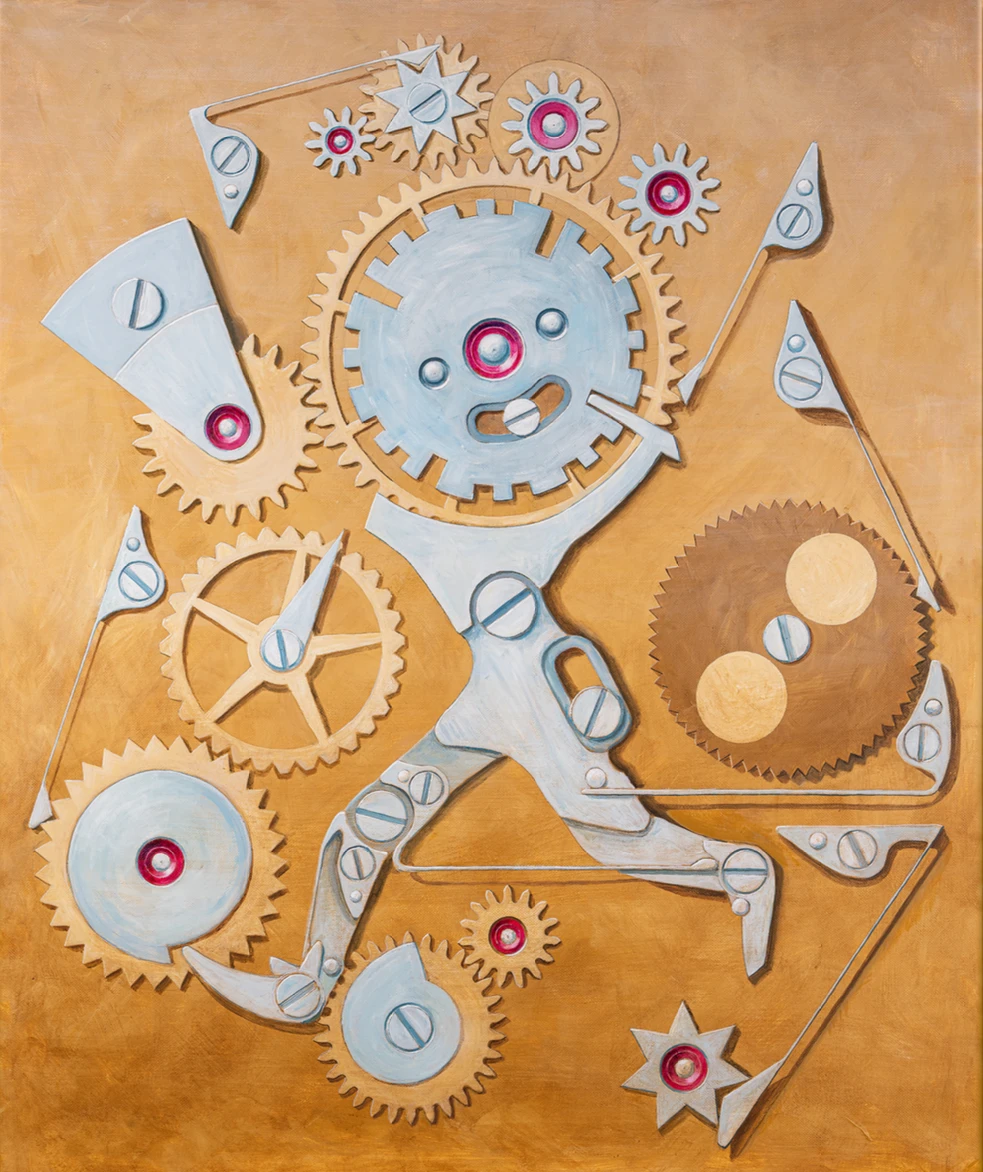
During the development of the perpetual calendar module for the «White Rabbit», Chaykin was struck by an unexpected discovery: the main switching lever of the calendar mechanism had taken on a peculiar form, resembling a solitary figure walking forward. Since the calendar was called “perpetual,” and the lever was destined to carry out its prescribed function indefinitely—as long as the watch remained wound—this immediately suggested to Chaykin a parallel with the medieval legend of Ahasverus, the Eternal Wanderer.
This impression was further reinforced by a linguistic coincidence: in German, the term “perpetual calendar” is written as «ewiger Kalender», which echoes the German name for the Wandering Jew: «der Ewige Jude». Moreover, the legend of the Wandering Jew (known in English as the «Wandering Jew» or «Eternal Wanderer») began circulating in Europe in the 13th century—around the same time that the earliest mechanical clocks appeared, striking the hours from city towers and belfries.
According to the legend, as Jesus carried his cross to Golgotha, He paused for a moment to catch His breath. A passerby pushed Him and said: “Move faster, Jesus! Why do You delay?” To this, Jesus replied: “I shall rest, but you shall walk until the Last Day.” Although neither the figure nor the legend itself are canonical, they have inspired countless interpretations in the works of artists, poets, and writers—including Gustave Doré and Marc Chagall, Heinrich Heine and Richard Wagner, Hans Christian Andersen and Isaac Asimov, Gabriel García Márquez and Jorge Luis Borges.
Konstantin Chaykin interprets the image of the Eternal Wanderer in his distinctive manner, symbolically, through the metaphor of a watch mechanism. Employing his “watchmaker’s palette” of colors—dominated by ochre, gray, blue, and red—Chaykin conceals the wandering figure within the intricate interplay of the calendar’s components, without aiming for literal resemblance. His «Ahasverus» is less a person than a function—eternal, yet forever imprisoned within the clockwork mechanism, which in metaphysical contexts is often seen as a metaphor for the universe itself.
A particular mood arises when contemplating this painting: the awareness that, somewhere in the hidden depths of the ultra-complicated «White Rabbit» wristwatch, the ceaseless work of the calendar continues—its main lever having become the prototype of the Eternal Wanderer, whom Konstantin Chaykin has captured on canvas in *Ahasverus*.
During the development of the perpetual calendar module for the «White Rabbit», Chaykin was struck by an unexpected discovery: the main switching lever of the calendar mechanism had taken on a peculiar form, resembling a solitary figure walking forward. Since the calendar was called “perpetual,” and the lever was destined to carry out its prescribed function indefinitely—as long as the watch remained wound—this immediately suggested to Chaykin a parallel with the medieval legend of Ahasverus, the Eternal Wanderer.
This impression was further reinforced by a linguistic coincidence: in German, the term “perpetual calendar” is written as «ewiger Kalender», which echoes the German name for the Wandering Jew: «der Ewige Jude». Moreover, the legend of the Wandering Jew (known in English as the «Wandering Jew» or «Eternal Wanderer») began circulating in Europe in the 13th century—around the same time that the earliest mechanical clocks appeared, striking the hours from city towers and belfries.
According to the legend, as Jesus carried his cross to Golgotha, He paused for a moment to catch His breath. A passerby pushed Him and said: “Move faster, Jesus! Why do You delay?” To this, Jesus replied: “I shall rest, but you shall walk until the Last Day.” Although neither the figure nor the legend itself are canonical, they have inspired countless interpretations in the works of artists, poets, and writers—including Gustave Doré and Marc Chagall, Heinrich Heine and Richard Wagner, Hans Christian Andersen and Isaac Asimov, Gabriel García Márquez and Jorge Luis Borges.
Konstantin Chaykin interprets the image of the Eternal Wanderer in his distinctive manner, symbolically, through the metaphor of a watch mechanism. Employing his “watchmaker’s palette” of colors—dominated by ochre, gray, blue, and red—Chaykin conceals the wandering figure within the intricate interplay of the calendar’s components, without aiming for literal resemblance. His «Ahasverus» is less a person than a function—eternal, yet forever imprisoned within the clockwork mechanism, which in metaphysical contexts is often seen as a metaphor for the universe itself.
A particular mood arises when contemplating this painting: the awareness that, somewhere in the hidden depths of the ultra-complicated «White Rabbit» wristwatch, the ceaseless work of the calendar continues—its main lever having become the prototype of the Eternal Wanderer, whom Konstantin Chaykin has captured on canvas in *Ahasverus*.